Commercial Real Estate Consultancy
Schedules Of Condition
Record the condition now. Protect your position later.
Taking on a commercial lease can mean accepting responsibility for repairs that may have little to do with your occupation.
A professionally prepared Schedule of Condition creates a detailed written and photographic record of the property at the start of the lease. When the repairing clauses are properly limited by reference to that Schedule, it can provide important evidence of defects, damage and deterioration that were already present before you moved in.
Fourth Wall prepares commercial Schedules of Condition for tenants and landlords across the UK, including offices, shops, restaurants, warehouses, logistics facilities, industrial units, nurseries, schools and other specialist commercial premises.
RICS Chartered Building Surveyors | UK-wide commercial coverage | Tenant and landlord-side dilapidations experience
Introduction
What is a Schedule Of Condition?
A Schedule of Condition is a detailed written and photographic record of a property’s condition at a specific point in time, usually prepared immediately before a tenant enters into a commercial lease.
Its purpose is to create clear evidence of the condition in which the property was handed over, including existing defects, damage, deterioration and previous alterations. Where the lease limits the tenant’s repairing obligations by reference to that condition, the Schedule can become an important part of establishing the tenant’s future liability.
A typical Schedule may include:
- Written descriptions of the principal building elements and finishes
- Photographs of existing defects, damage and deterioration
- Clear references to rooms, elevations and specific locations
- Records of previous repairs or alterations where visible
- Details of the inspection date and conditions
- Notes of any areas that could not be accessed or inspected
- Marked-up plans or drawings where these help locate defects
A good Schedule is not simply a large collection of photographs. The information should be detailed and structured enough that a surveyor, solicitor or property manager reviewing it several years later can understand what was defective, where it was located and the condition of the property when the lease began. To produce an effective one requires input from an experienced chartered surveyor with extensive knowledge of dilapidations matters
Who Can Instruct a Schedule of Condition?
A Schedule of Condition can be commissioned by various parties, including:
- Landlords
- Tenants
- Employers
- Contractors
- Neighbours
Engaging an independent expert like Fourth Wall Building Consultancy to complete the Schedule of Condition adds authority and reliability to the record, which can be crucial during disputes, claims, or negotiations.
Schedule of Condition vs Condition Survey: What’s the Difference?
It’s important to distinguish between a Schedule of Condition and a Condition Survey:
- Schedule of Condition: A detailed record with descriptive annotations and photographic evidence of a property’s condition at a specific date, often appended to a legal document such as a lease or Party Wall Award.
- Condition Survey: Focuses on identifying the overall condition of a property and recommending any necessary repairs or maintenance works.
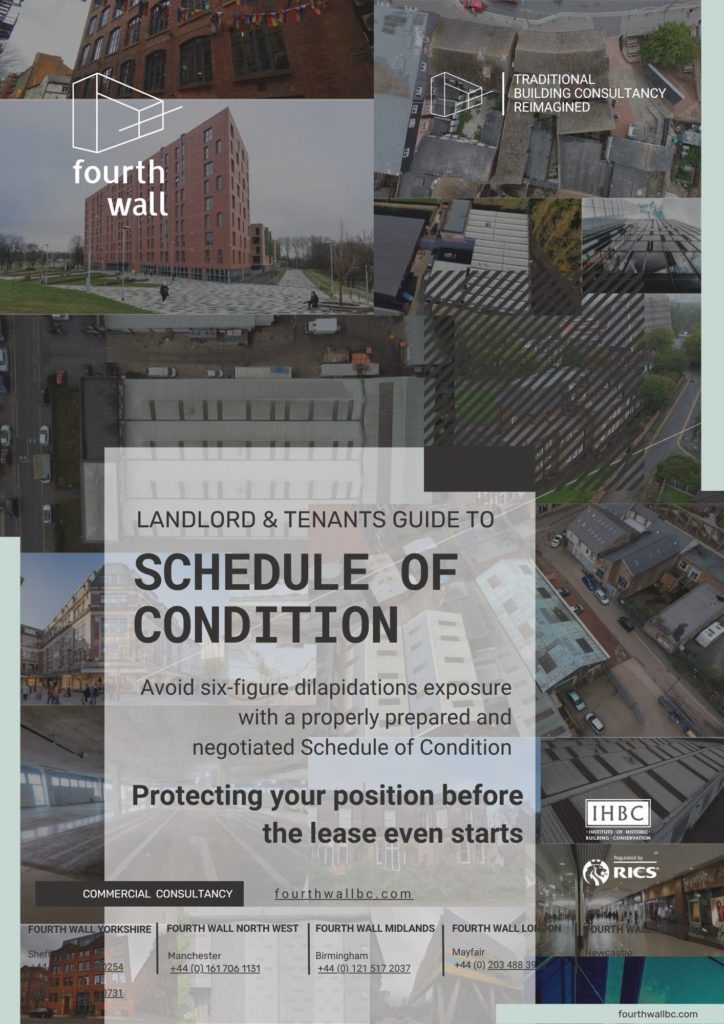
Download the Schedule of Condition Guide: For Landlords, Tenants & Occupiers
A Schedule of Condition is one of the most effective ways to manage risk at the start of a commercial lease. Whether you are a landlord protecting your asset or a tenant seeking to limit dilapidations liability, a professionally prepared schedule provides a clear, defensible record of the property’s condition at lease commencement.
This practical guide explains how Schedules of Condition work in the real world, not just in theory, and how they are used to support lease negotiations and minimise disputes at lease expiry.
Inside this guide, you’ll learn:
- How it can limit tenant liability for repairs and reinstatement
- What a Schedule of Condition is and how it forms part of a commercial lease
- Common mistakes made by landlords, tenants and advisers
- When a photographic schedule is sufficient and when a full survey is required
- How Schedules of Condition are used in dilapidations claims and negotiations
- What to look for when instructing a surveyor
Why does a commercial tenant need a Schedule of Condition?
When taking a commercial lease, one of the biggest risks is assuming that you will only be responsible for damage or deterioration that happens after you move in.
That is not always the case.
Your repairing obligations are determined by the lease, and a broadly drafted covenant can require you to put parts of the property into repair even where defects already existed before your tenancy began.
This can create significant exposure where you are taking:
- A full repairing and insuring lease
- An older or poorly maintained building
- A warehouse or industrial unit with an ageing roof or cladding
- A retail or hospitality property with previous tenant alterations
- Premises showing signs of damp, water ingress or structural deterioration
- A property with extensive yards, hardstanding, boundaries or external areas
- A building that has recently been cosmetically refurbished but still contains underlying defects
A properly prepared Schedule of Condition provides evidence of the property’s starting condition and can support lease wording that limits your obligation to return it in any better condition than that recorded at commencement.
It should be read alongside the lease, not as a substitute for it. Your solicitor should ensure the repairing provisions are drafted so that the Schedule has the intended contractual effect.
Learn more about our Pre-Lease Survey and Schedule of Condition service
A professionally prepared Schedule of Condition survey typically forms part of lease negotiations and can significantly reduce exposure to dilapidations claims. The cost of preparing a schedule is often minimal compared to the potential liabilities associated with a full repairing obligation.
Why choose Fourth Wall for your Schedule of Condition?
A Schedule of Condition can look straightforward, but its value depends on the experience of the person inspecting the property and the quality of the record they create. We prepare Schedules with the later lease position in mind, not simply as a photographic exercise.
Experienced Chartered Building Surveyors
Our inspections are undertaken by experienced building surveyors who understand commercial construction, building defects and lease repair liability.
That means the surveyor is not simply recording that something is “damaged” or in “fair condition”. They understand what is significant, what needs to be described clearly and which areas are likely to matter if the Schedule is relied on later.
We work with Schedules at both ends of the lease
Fourth Wall advises landlords and tenants on commercial dilapidations, repair liability assessments and lease-end negotiations.
That gives us first-hand experience of how Schedules of Condition are interpreted years after they were prepared.
We know the weaknesses that regularly cause problems, including:
- Vague defect descriptions
- Photographs with no clear location
- Important parts of the demise being omitted
- Poor records of the extent of deterioration
- Limited coverage of roofs and external areas
- Failure to properly record previous tenant alterations
We use that experience when preparing the original Schedule.
Practical building knowledge, not just standard clauses
The quality of the advice depends heavily on the surveyor’s experience.
A surveyor who regularly deals with roof failures, water ingress, cladding defects, floor damage, historic repairs and building maintenance is better placed to understand what needs to be recorded and how clearly it should be evidenced.
We combine surveying knowledge with practical experience of repair, refurbishment and construction projects, so the Schedule reflects the building in front of us rather than a generic reporting template.
A well-prepared Schedule of Condition is one of the most effective ways to protect all parties in a property agreement. It provides a clear, unbiased record of the building’s condition—removing ambiguity and reducing the risk of costly disputes down the line.
Joshua Weston BSc(Hons) MRICS, Director – Fourth Wall Lead Director
RICS Appointed Member of the Professional Group Panel for Building Surveying & Building Control
Real Buildings. Real Insight.
How we deliver clarity, value and strategic advice across the UK.
Our case studies show how Fourth Wall works in practice from navigating complex dilapidations claims and delivering development monitoring for commercial clients, to guiding heritage refurbishments and producing detailed RICS building surveys. Explore how we help landlords, asset managers, occupiers and developers make confident, informed decisions about the buildings they own, manage or occupy.


A Schedule of Condition does not automatically protect you
A Schedule of Condition is evidence of the property’s condition. It does not, by itself, change your repairing obligations.
For the Schedule to provide the intended protection, the lease needs to clearly state how your repairing covenant is limited by reference to the condition recorded within it.
For example, the lease may provide that you are not required to return the premises in any better condition than evidenced by the Schedule at lease commencement. The exact wording should be agreed by your solicitor.
This distinction matters because a tenant can have a detailed Schedule of Condition and still remain exposed to a wider repairing obligation if the lease does not refer to it properly.
The strongest position is therefore achieved when the surveyor and solicitor work together before the lease completes: the surveyor records the condition accurately, and the solicitor ensures the lease gives that record the intended contractual effect.
What does a commercial Schedule of Condition include?
The exact scope should reflect the property, the lease and the areas you are taking responsibility for.
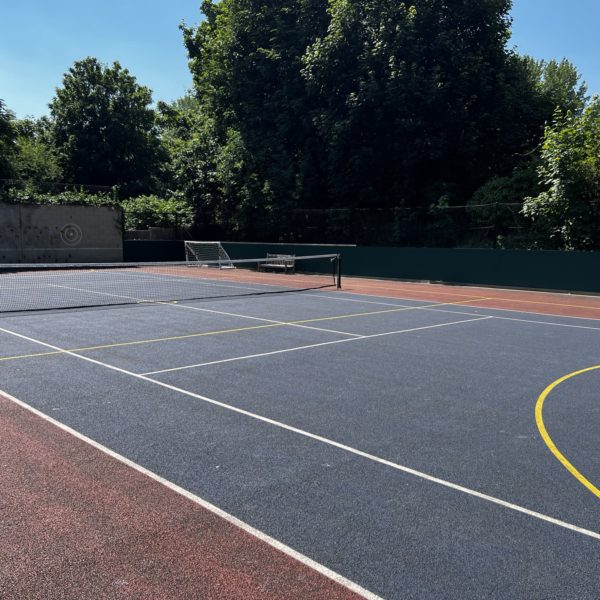
For a straightforward shop or office, the Schedule may focus mainly on the internal accommodation and frontage. For an industrial, logistics or standalone commercial building, it may need to extend to roofs, external walls, yards, hardstanding, drainage, boundaries and other significant elements.
A typical Schedule may record:
Roofs and rainwater goods
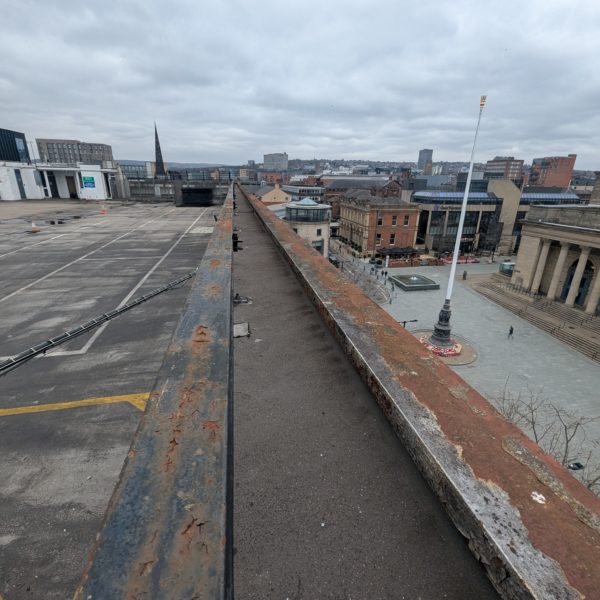
Roof coverings, rooflights, flashings, gutters, downpipes, previous repairs, corrosion, coating failure, damaged seals and visible signs of water ingress.
External walls and cladding
Brickwork, stonework, render, profiled cladding, pointing, cracking, staining, impact damage, corrosion and previous repairs.
Windows, doors and shopfronts
Frames, glazing, sealants, entrance doors, personnel doors, loading doors, roller shutters and any existing damage, deterioration or operational defects visible at the time of inspection.
Internal areas
Walls, floors, ceilings, decorations, partitions, doors, joinery, fixed finishes, previous fixing holes, impact damage, staining, damp and other visible deterioration.
Industrial and warehouse areas
Concrete floor slabs, loading bays, mezzanines, structural elements visible from within, cladding, racking-related damage, vehicle impact, loading doors and high-level areas where accessible.
External areas
Yards, hardstanding, car parks, access roads, kerbs, drainage channels, fencing, gates, boundaries, retaining structures and external stores.
Visible building services
The visible condition of building services can be recorded, but a standard Schedule of Condition is generally a visual, non-intrusive inspection. It does not normally include specialist testing of mechanical, electrical, gas, drainage, fire safety or other installations unless separately agreed.
The important point is that the Schedule should follow the demise and repairing obligations, not simply a standard template. If the lease makes you responsible for a roof, yard or boundary, those areas need to be considered properly within the inspection scope.
How is a Schedule of Condition prepared?
A useful Schedule of Condition starts with understanding what the tenant is actually taking responsibility for.
Before inspection, we review the available property and lease information so the survey can be focused on the correct areas and potential liabilities.
1. We review the property information
Where available, we consider:
- Marketing particulars
- Heads of terms
- Draft lease
- Lease plan
- Proposed repairing obligations
- Details of any landlord works
- Existing plans or previous condition information
This helps us establish the extent of the demise and identify any areas that may need particular attention.
2. We inspect the property
An experienced building surveyor undertakes a systematic visual inspection of the agreed areas, recording existing defects, damage, deterioration, previous repairs and alterations.
The inspection is structured around the building rather than simply following a generic photographic checklist.
3. We prepare the written and photographic Schedule
The report combines clear written descriptions with photographs that identify the location, nature and extent of the condition being recorded.
Where useful, plans or marked-up drawings can be used to help locate defects.
4. The draft Schedule is reviewed
The Schedule can be circulated to the tenant, landlord, solicitors or landlord’s surveyor for review.
Where factual comments are raised, we can consider and respond to them so that the final document provides an accurate record of the property at lease commencement.
5. The final Schedule is incorporated into the lease
Your solicitor should ensure the agreed Schedule is properly referred to within the lease and that the repairing provisions give it the intended effect.
The process is most effective when the survey is commissioned early enough to allow inspection, drafting, review and agreement before the lease completes or fit-out works begin.
When should you commission a Schedule of Condition?
Ideally, a Schedule of Condition should be commissioned before the lease completes and before you begin fit-out works or occupation.
The aim is to record the property in the condition in which it is being handed over to you, before that condition is altered by your own works, furniture, equipment or day-to-day use.
Commissioning it early gives you time to:
- Inspect the property properly
- Record existing defects and damage
- Identify areas that may need further investigation
- Raise significant issues with the landlord
- Agree any landlord works
- Negotiate limitations to the repairing covenant
- Allow your solicitor to incorporate the Schedule into the lease
Leaving the inspection until after occupation can make it much harder to establish whether a defect was pre-existing or arose during your tenancy.
Where the lease is progressing quickly, it is still worth obtaining advice as early as possible. A short programme is usually easier to manage before completion than trying to reconstruct the property’s original condition afterwards.
Taking a property on a full repairing and insuring lease?
A full repairing and insuring lease, often shortened to an FRI lease, can place extensive responsibility for the condition of the property on the tenant.
Depending on how the lease is drafted, you may be responsible for repairing and maintaining:
- Roofs
- External walls and cladding
- Windows and doors
- Internal finishes
- Building services
- Yards and hardstanding
- Drainage
- Fences, gates and boundaries
- Decoration and ongoing maintenance
This can create significant exposure where the property is older, poorly maintained or already showing signs of disrepair.
A common misconception is that you will only be responsible for deterioration that occurs after you move in. In practice, a wide repairing covenant can potentially require you to put the property into repair, even where defects were already present at the start of the lease.
That is why the condition of the building and the wording of the lease need to be considered together.
Before accepting an FRI lease, ask two separate questions:
What condition is the property actually in today?
What condition will the lease require me to maintain or return it in?
A Schedule of Condition can help record the first. A properly drafted lease is needed to deal with the second.
Where you need advice on defects, likely repairs, future costs or negotiating points, our Pre-Lease Survey and Schedule of Condition service may be more appropriate than a standalone Schedule.
Schedule of Condition or Pre-Lease Survey?
A Schedule of Condition and a Pre-Lease Survey are often commissioned at the same stage of a transaction, but they serve different purposes.
A Schedule of Condition records the property as it is.
It is primarily an evidential document, used to establish the condition of the premises at lease commencement and support any agreed limitation to the tenant’s repairing obligations.
It is generally suitable where:
- You have already decided to take the property
- The lease is intended to be limited by reference to existing condition
- You need a clear written and photographic record
- The building is relatively straightforward
- You do not require detailed advice on defects, repairs or future expenditure
A Pre-Lease Survey goes further and advises you on the risks of taking the property.
It can consider:
- Significant defects and their likely cause
- Repairs that may be required during the lease
- Likely maintenance liabilities
- Areas requiring further investigation
- Potential budget costs
- Issues to raise with the landlord
- Landlord works that should be agreed before completion
- Whether the proposed repairing obligations are proportionate to the condition of the building
For older, larger or more complex properties, or where you are taking an FRI lease, a Pre-Lease Survey may provide substantially more useful information than a Schedule alone.
In many cases, the two services can be combined: the survey informs your decision and negotiations, while the Schedule provides the record that supports the final lease position.
Learn more about our Pre-Lease Survey and Schedule of Condition service
Prepared with lease-end disputes in mind
A Schedule of Condition is often prepared at the beginning of a lease, but its real value may only become apparent years later when the tenant is leaving.
Fourth Wall advises both landlords and tenants on commercial dilapidations, including Schedules of Dilapidations, repair liability assessments and lease-end negotiations.
That gives us a practical understanding of how Schedules of Condition are actually used when liability is being debated.
We know where problems commonly arise, including:
- Photographs that do not clearly identify the defect
- Vague descriptions that leave room for interpretation
- Important areas of the demise being missed
- No evidence of the extent of deterioration
- Poor records of previous tenant alterations
- Inadequate coverage of roofs, yards and external elements
- Differences between the condition recorded and the obligations imposed by the lease
That experience feeds directly into how we prepare Schedules at lease commencement.
The aim is not simply to produce a detailed report for the file. It is to create a record that remains clear, useful and defensible if it needs to be relied on during a future dilapidations discussion.
Why the quality of the Schedule matters
A Schedule of Condition may not be relied on until many years after it was prepared.
By that point, the people involved in the original transaction may have moved on, the property may have changed significantly and the only available evidence of its starting condition may be the Schedule itself.
That is why quality matters. A weak Schedule often contains:
- Large numbers of photographs with little explanation
- Images that do not clearly show where they were taken
- Generic descriptions such as “fair condition”
- No record of the extent of a defect
- Important areas omitted from the inspection
- No clear distinction between separate building elements
- Poor coverage of roofs, external areas or high-level defects
- No reference to areas that could not be inspected
These weaknesses can create uncertainty later, particularly during a dilapidations claim.
A good Schedule should allow a surveyor who was not present at the original inspection to understand:
- What was defective
- Where the defect was located
- How extensive it was
- What condition the surrounding element was in
- Whether the issue was isolated or repeated elsewhere
The objective is not to produce the greatest number of photographs. It is to create clear, usable evidence that remains meaningful throughout the lease term.
Schedules of Condition for different types of commercial property
The scope of a Schedule of Condition should reflect the type of property, how it is constructed and the areas the tenant is taking responsibility for.
A retail unit, warehouse, nursery and restaurant may all require a Schedule, but the defects and liabilities that matter can be very different.
Industrial and manufacturing units
Industrial premises can carry significant repair exposure because the demise often includes high-value external elements.
Particular attention may be required to:
- Roof coverings and rooflights
- Profiled cladding
- Gutters and rainwater goods
- Loading doors
- Concrete floor slabs
- Mezzanines
- Yards and hardstanding
- Fencing and gates
- Vehicle-impact damage
- Previous machinery fixings and penetrations
For older units, even relatively localised roof or cladding defects can become expensive if the lease places full repair responsibility on the tenant.
Restaurants, cafés and hospitality premises
Hospitality properties can contain intensive fit-out and specialist installations that create both repair and reinstatement risks.
Relevant areas may include:
- Commercial kitchens
- Extract routes and penetrations
- Cellars and stores
- Cold rooms
- Internal finishes
- Drainage points
- Sanitary accommodation
- Fire separation visible during inspection
- External seating or servicing areas
- Damage arising from previous fit-out
Schools, colleges and education premises
Education properties can include multiple buildings and a wide variety of specialist spaces.
The inspection may need to cover:
- Classrooms
- Offices
- Circulation areas
- Sports and assembly spaces
- Kitchens and dining areas
- Laboratories or specialist rooms
- External grounds
- Roofs and elevations
- Boundaries and fencing
- Existing adaptations and alterations
Warehouses, logistics and last-mile facilities
Larger logistics properties can include extensive roofs, yards, loading areas and perimeter infrastructure.
A Schedule may need to record:
- Dock levellers and loading bays
- Roller shutter doors
- High-bay warehouse areas
- Rooflights
- Racking-related damage
- Floor slab defects
- Service yards
- Drainage channels
- Trailer parking areas
- Gates, fencing and boundaries
Because of the scale of these sites, clear location references are particularly important.
Offices
Office premises can appear to be in good condition while still containing substantial previous tenant alterations.
A Schedule may record:
- Raised access floors
- Suspended ceilings
- Partitioning
- Floor boxes and cabling openings
- Fixed joinery
- Kitchens and welfare areas
- Decorations and finishes
- Previous fit-out installations
- Existing leaks or staining
- Landlord fixtures
Charities and third-sector occupiers
Charities and community organisations often take older or adapted buildings where repair liabilities can be disproportionate to the rent being paid.
A Schedule can help establish a clear record of:
- Existing defects
- Previous alterations
- Older finishes
- External deterioration
- Landlord works
- Areas of inherited disrepair
Where future expenditure is a concern, a Pre-Lease Survey may be more useful than a standalone Schedule because it can also provide advice on repairs and potential costs.
Retail premises
Retail units often contain several generations of tenant fit-out, making it important to distinguish between existing damage, landlord fixtures and previous alterations.
The Schedule may include:
- Shopfronts and glazing
- Entrance doors and shutters
- Suspended ceilings
- Floor and wall finishes
- Rear storage areas
- Basements
- Service yards
- Existing signage
- Previous partitioning and fixing holes
- Evidence of damp or water ingress
Nurseries and childcare premises
Nurseries often occupy adapted buildings and can include extensive internal and external areas.
The Schedule may record:
- Playrooms
- Changing and sanitary areas
- Fixed joinery
- Internal finishes
- Safety-related alterations
- External play areas
- Fencing and gates
- Outbuildings
- Existing wear associated with intensive use
Healthcare and specialist-use premises
Clinical and specialist properties can contain extensive adaptations and fixed installations.
A Schedule may record:
- Treatment and consulting rooms
- Hygienic finishes
- Fixed cabinetry
- Accessible facilities
- Service penetrations
- Previous clinical installations
- Staff and welfare areas
- Plant and servicing spaces
Where the operation relies on existing building services, separate specialist testing may also be required.
How much does a Schedule of Condition cost?
The cost of a commercial Schedule of Condition depends on the size, type and complexity of the property, together with the extent of the demise, access requirements and reporting timescale.
A small retail unit with straightforward access will usually require less inspection and reporting time than a large warehouse, logistics facility or industrial site with roofs, loading areas, yards and extensive external boundaries.
Factors that can affect the fee include:
- Property size and layout
- Building type
- Extent of the tenant’s demise
- Number of buildings or separate areas
- Roof and high-level access
- External yards, car parks and boundaries
- Existing condition and level of detail required
- Operational or restricted access
- Required turnaround
For an immediate indication, use our dedicated Commercial Schedule of Condition Cost Calculator.
It will provide an indicative fee based on the property information you enter. We will then review the particulars, scope and access requirements before confirming a fixed quotation.
Ready to take the next steps?
Book Your Schedule Of Condition Survey
We’ve torn down the traditional, jargon-heavy surveying model to create a service to suit you. Rely on our team of RICS surveyors to accurately detail every inch of your property, and for follow-up advice should you need it in future. If you’d like to get in touch for a free consultation and quote, please click the button below. Alternatively, contact us by phone or email and we’ll get back to you.
Schedule Of Condition FAQs
Browse some of the common questions that our team are asked when it comes to choosing the survey that’s right for you.
Not every commercial lease requires one, but a Schedule of Condition is particularly valuable where the tenant’s repairing obligations are intended to be limited by reference to the property’s existing condition.
It can be especially important where:
The property is older or already showing signs of disrepair
You are taking a full repairing and insuring lease
The lease includes roofs, external walls, yards or boundaries
Previous tenant alterations remain
The landlord has only carried out cosmetic refurbishment
You are concerned about future dilapidations liability
The Schedule creates evidence of the property’s starting condition. Your solicitor should then ensure the lease wording gives that evidence the intended effect.
No. There is no general legal requirement for every commercial tenant to obtain one.
It is a risk-management tool used to record the condition of the property and support any agreed limitation to the tenant’s repairing obligations.
Whether you need one depends on the lease, the property and the level of repair liability you are being asked to accept.
Potentially, yes. If its professionally drafted and agreed. A Schedule can help limit repair liability where the lease expressly states that the tenant is not required to put or return the property into any better condition than that evidenced by the Schedule. The document itself does not change the lease. The repairing covenant must be drafted appropriately by your solicitor.
Yes, potentially.
A broadly drafted repairing covenant can require a tenant to put premises into repair even where the defect existed before the lease commenced.
This is why it is important to consider the condition of the building and the wording of the lease together.
A Schedule of Condition can provide evidence of existing defects, but the lease must use that evidence correctly.
Possibly.
If the lease requires you to put and keep the property in repair, you may inherit responsibility for defects that pre-date your occupation.
That can be particularly significant with older industrial, retail and hospitality properties where roofs, cladding, windows, drainage or external areas are already deteriorating.
Where you need advice on the likely repair liability as well as a record of condition, consider a Pre-Lease Survey and Schedule of Condition.
A full repairing and insuring lease, commonly referred to as an FRI lease, generally places extensive repair responsibility on the tenant.
Depending on the lease structure, this may include:
Roofs
External walls
Windows and doors
Internal finishes
Building services
Yards and hardstanding
Drainage
Fences and gates
Decoration and maintenance
The key point is that an FRI lease may require more than simply maintaining the property in the condition in which you received it.
It can mean that if part of the property is already out of repair when the lease begins, the tenant may first have to put it into repair and then maintain it for the rest of the lease.
That distinction can create significant cost exposure.
A Schedule of Condition can help establish the starting condition, but the repairing covenant must be limited appropriately if the intention is to avoid inheriting existing disrepair.
For many properties, yes.
A Schedule of Condition records the existing condition, but it does not normally provide detailed advice on:
The cause of defects
Their significance
Likely repair costs
Future maintenance
Further investigations
Whether the landlord should carry out works
Whether the proposed lease terms are commercially sensible
If you need that level of advice before committing, a Pre-Lease Survey is likely to be more appropriate.
A Schedule of Condition records what is there.
A Pre-Lease Survey explains what it means.
The Schedule is primarily evidential. The pre-lease survey provides advice on defects, repair requirements, likely expenditure and areas that may need to be negotiated before the lease completes.
The two services can also be combined.
Ideally, before the lease completes and before you begin fit-out works or occupation.
That allows the property to be recorded in the condition in which it is being handed over to you.
It also gives time for:
The Schedule to be drafted
Any comments to be reviewed
Landlord works to be agreed
Repair obligations to be negotiated
The final document to be incorporated into the lease
A retrospective Schedule can sometimes still be useful, but its evidential value may be weaker.
Once you have taken occupation, it can become harder to establish whether damage or deterioration existed beforehand or arose during your tenancy.
We can review the lease, occupation date and any historic photographs before advising whether a retrospective Schedule is worthwhile.
The final agreed Schedule should be clearly referred to within the lease and attached, annexed or otherwise retained with the completed lease documentation.
Your solicitor should ensure that the lease wording explains how the Schedule affects the repairing obligations.
You can, but a DIY photographic record often has weaknesses.
Common problems include:
Missing important areas
Photographs with no clear location
No written defect descriptions
Poor coverage of roofs or external areas
No record of the extent of damage
Failure to distinguish different building elements
No clear connection with the lease demise
A professionally prepared Schedule provides a more systematic and independent record.
Not usually on its own.
Photographs are useful evidence, but they need context.
A good Schedule should explain:
What the defect is
Where it is located
How extensive it is
Which element is affected
Whether the issue is repeated elsewhere
This makes the document much easier to interpret several years later.
The scope depends on the property and the areas included within the lease.
It may include:
Roofs and rooflights
External walls and cladding
Windows and doors
Internal finishes
Concrete floor slabs
Loading areas
Yards and hardstanding
Fencing and gates
Drainage
External stores
Visible building services
Previous repairs and alterations
The exact scope should follow the demise and repairing obligations rather than a generic checklist.
The lease determines responsibility.
Some tenants are responsible only for internal areas. Others may be responsible for the whole building, including the roof, external walls, windows, yards and boundaries.
In multi-let properties, the landlord may retain responsibility for certain elements and recover the cost through the service charge.
Do not assume that a defect is the landlord’s responsibility simply because it existed before you moved in.
Potentially, yes.
If a survey identifies significant defects, you may be able to negotiate:
Landlord repairs before completion
A schedule of landlord works
A limitation to the repairing covenant
A financial contribution
A rent-free period
Different commercial terms
The appropriate strategy will depend on the defect, the lease and the wider transaction.
Landlord’s works are repairs, alterations or improvements that the landlord agrees to carry out as part of the letting.
Examples might include:
Repairing a leaking roof
Replacing damaged cladding
Repairing windows
Completing drainage works
Bringing building services into working order
Carrying out agreed compliance works
These works should be clearly documented rather than relying solely on informal discussions with the letting agent.
Significant condition issues should ideally be raised as early as possible.
Heads of terms can record the broad commercial agreement around:
A proposed Schedule of Condition
Repair limitations
Landlord works
Fit-out
Reinstatement
Contributions toward repairs
The detailed legal wording is then dealt with by the solicitors.
No.
A landlord can still pursue a claim where there are breaches of obligations that are not limited by the Schedule or where the property has deteriorated during the lease.
The Schedule is evidence of the starting condition. It is not a complete defence to every lease-end claim.
Many commercial leases require tenants to remove alterations and reinstate the property at lease expiry.
This can include:
Partition walls
Racking
Mezzanines
Kitchen installations
Extraction systems
Signage
Cabling
Raised floors
Specialist equipment
The exact obligation depends on the lease and any licences for alterations.
Recording the property before fit-out begins can make it much easier to establish the original configuration later.
Possibly.
The lease, licences for alterations and any reinstatement provisions will determine what must be removed.
This should be considered when the fit-out is being planned, not only when the lease is about to expire.
The fee depends on the property’s size, type, location, condition, extent and access requirements.
A small retail unit will generally require less inspection and reporting time than a large warehouse with roofs, yards, loading areas and extensive external boundaries.
Use our Commercial Schedule of Condition Cost Calculator for an indicative fee.
The timescale depends on the size and complexity of the property, access arrangements and the level of detail required.
It is best to commission the survey as early as possible so there is enough time for inspection, drafting, review and agreement before the lease completes.
Often, subject to surveyor availability and property access.
If the transaction is moving quickly, send us the property address, marketing particulars, heads of terms and proposed completion date as early as possible.
We can then confirm the earliest realistic inspection and reporting programme.
Yes.
Fourth Wall undertakes commercial property instructions across the UK, including Yorkshire, the North West, Midlands, London, the South East and wider regions.
Send us the property address or use our Schedule of Condition Cost Calculator to start the process.
Local Knowledge
National Coverage.
We have surveyors based across England in our regional offices. With expert knowledge of their local areas, you know you’re in safe hands.
Fourth Wall // South East
Areas We Cover
London
Mayfair
Pimlico
Kensington
Westminster
Lambeth
Islington
Enfield
Camden
Barnet
Belsize Park
Hampstead Heath
Finsbury Park